



Are you having trouble picking a coding course?
There are too many ads. Too many promises.
Everyone says they are the “best.”
You just want to know how to pick coding classes that will help you reach your career goals. There are thousands of online programming classes on sites like Coursera, Udemy, edX, and specialised bootcamps. The sheer number of options has made it hard to choose what to do.
This guide makes things easier. You’ll learn a useful way to look at courses, see if they fit your goals, and avoid spending months on the wrong program.
The Problem: Why Picking an Online Coding Course Can Be So Hard
The market for online learning has grown a lot. Research and Markets says that by 2026, the global e-learning market will be worth $457.8 billion. Coding education is one of the fastest-growing parts of this huge industry.
Here is what makes the choice so hard:
Hundreds of websites offer online programming classes, but the quality of these classes varies.
You can choose from many languages, such as Python, JavaScript, Java, C++, Go, Rust, and more.
There are huge price differences between free YouTube tutorials and bootcamps that cost more than $20,000.
There is also confusion about “job guarantee” terms and conditions.
Most beginners choose based on the wrong things:
Picking things based on what everyone else is doing instead of what you want to do—like signing up for whatever is popular on social media
Copying what your friends do without knowing if it will help you reach your goals
Choosing the wrong language that doesn’t fit with their career goals
Not thinking about long-term growth and just trying to get through the course
A Stack Overflow survey found that 65% of developers learned on their own to some extent. However, those who followed structured learning paths were happier at work and moved up the career ladder faster.
The format is just as important as the content:
Self-paced classes vs. live classes: Self-paced classes let you work at your own pace, but you have to be disciplined. Live classes give you structure and let you interact with others in real time.
Bootcamps vs. programs with a set structure: Bootcamps last for 12 to 16 weeks, while structured programs last for 6 to 12 months.
Courses that are short-term vs. those that are career-focused: Short courses teach specific skills, while long programs prepare you for a full career.
Learning paths that are free vs. paid: There are a lot of free resources, but they don’t offer career or mentoring help.
What Happens If You Pick the Wrong Course?
Making a bad choice has real effects:
Months wasted learning skills that are no longer useful to employers—technologies that were popular five years ago
Because the course was mostly theory and didn’t have any real-world projects, I don’t have a portfolio to show employers.
Not being able to pass technical tests because you didn’t prepare well for the interview
Frustration and burnout from not knowing what to do next
A Course Report survey from 2023 found that students who didn’t do enough research on their bootcamp were three times more likely to drop out.
There is a high dropout rate in coding classes. Here’s why:
No plan: Students feel lost without a clear path from beginner to job-ready.
No one to help: If you get stuck on mistakes and can’t get help, you’ll give up.
Too much material in the curriculum: Too much information without the right support makes you freeze up.
Not sure what to do with your career: Learning without a goal quickly kills motivation.
Not just the obvious:
Losing money by paying for classes that don’t work.
Losing interest after realising you made the wrong choice.
Starting over from scratch and losing three to six months of learning time.
Not sure what to do next, even after finishing the program.
A Useful Guide to Help You Pick the Right Coding Course for You
- Step 1: Make sure you know exactly what you want to do with your coding career.
Answer these questions before you look at any course:
- Do you want to work as a developer full-time for a company?
- Are you looking for freedom and income from freelancing?
- Are you thinking about changing careers from a non-technical field?
- Want to start a business but need technical skills?
The language you learn, how much you need to know, and what kind of course will help you the most all depend on your goal.
- Step 2: Choose the Right Language for Your Project
Not every language is good for the same thing. Here’s how to pick a beginner’s coding course based on what you want to do with your career:
For Making Websites
- First, learn HTML, CSS, and JavaScript.
- Go to React or Vue for the front end.
- Add Node.js to the backend (Full Stack roadmap).
For Making Software
- Java for business apps.
- Python is flexible and easy to read.
- C++ for programming systems.
For Jobs in Data Science and AI
- Python is the standard in the field.
- Add SQL to manage the database.
- Learn how to use Tableau and other data visualisation tools.
For Mobile Development
- Swift for iOS and Kotlin for Android are the best languages for mobile development.
- React Native for all platforms
You should choose a language based on your coding career path, not the other way around.
- Step 3: The Right Way to Compare Online Programming Classes
When looking for the best online programming classes to help you grow in your career, keep an eye out for:
- Updated curriculum: Technology changes quickly. At least once a year, courses should be updated.
- Real-world projects: You need 3 to 5 real-world projects for your portfolio, not just coding exercises.
- Mentor access: You can talk to experienced developers directly and ask them questions or look over your code.
- Placement transparency: There are clear numbers on the average time it takes to hire a graduate, the average salary range, and the number of graduates who get jobs.
- Industry relevance: The curriculum is in line with what employers want and what is needed in the job market right now.
SwitchUp’s research shows that courses with dedicated mentorship have a 40% higher completion rate than those without.
- Step 4: See if the course will help you with your long-term coding career.
These are the most important questions to ask:
- Does it have projects that you can show employers that are good for your portfolio?
- Are there mock interviews and coding challenges as part of the interview prep?
- Are there internships or placements where you can get real-world experience?
- Does it teach companies how to do things, or just ideas?
A full course should get you ready for the whole job search, not just teach you how to code.
- Step 5: Before you choose a coding course, think about how much time and money you can spend.
Be honest about what you can do:
- How many hours a week can you really put in? Most students who do well spend 15 to 20 hours a week studying.
- Can you handle live classes with your current schedule, or do you need to go at your own pace?
- If you choose a paid program, is EMI an option?
- What is the possible return on investment? In the US, entry-level developers make between $65,000 and $85,000 a year.
Should You Take Free or Paid Online Programming Classes?

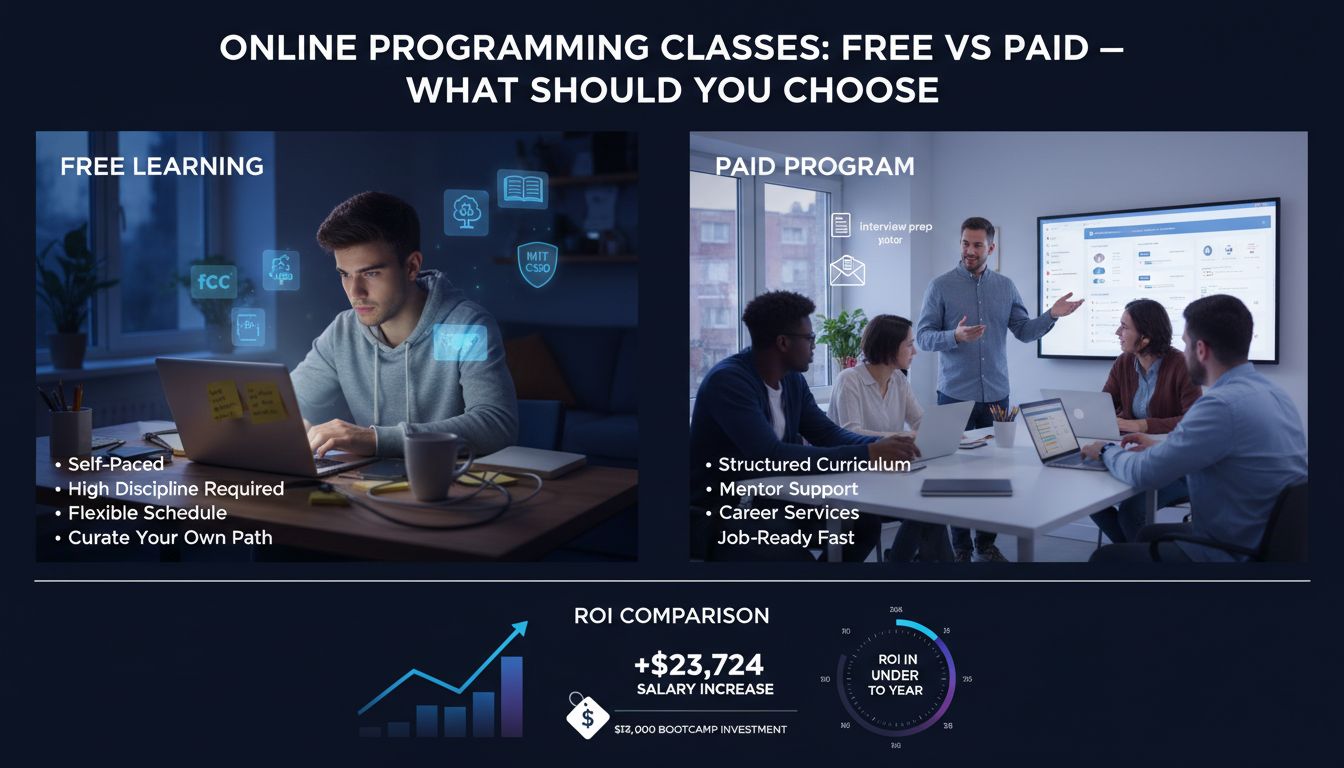
A Quick List to Help You Pick a Coding Course You'll Be Happy With
- A clear career goal that is written down
- Language skills that match the job you want
- Projects that are useful to you in real life
- A mentor who is available to help you quickly
- A clear placement record with proof of data
- A budget that works for you without causing financial stress
Real Examples: Choosing the Right Course for Your Career Goals
Best option: A full bootcamp or structured program lasting 4 to 6 months.
Focus on: Full-stack development with portfolio projects.
Best option: The best option is a bootcamp that focuses on changing careers and guarantees jobs.
Focus on: Pay attention to the basics, how to prepare for an interview, and soft skills.
Timeline: 6 to 9 months, including the job search
Best option: The best choice is project-based courses that teach skills that are in high demand.
Focus on: Focus on: WordPress, Shopify, and frontend frameworks
Best option: The best choice is free resources and beginner courses.
Focus on: Trying out different languages to see which one works best for you
Time frame: 2 to 3 months of research before making a decision
Don't just take a class; make a career out of coding.
Stop following trends. A language that is popular today might not be as popular tomorrow, but basic programming skills will always be useful.
Pay attention to where you’re going. Your coding career path should be based on your own goals, lifestyle choices, and long-term vision, not just what someone else did.
Make smart choices. Use the framework in this guide to look at options based on facts, not what the company says.
Think about growth over time. The best course isn’t always the quickest or least expensive one. It’s the one that gives you a strong base for learning more and moving up in your career.
The right online programming classes can change your career, but only if they fit with your goals. You’ll be glad you took the time to make the right choice in a year.
FAQs – The Best Online Coding Courses in India
First, figure out what you want to do with your life, and then choose a language that will help you get there. Look for classes that have projects you can do, a mentor to help you, and clear ways to learn. Structured programs should come before random tutorials for beginners.
Yes, but only if you choose wisely. Quality online programming classes offer structured learning, mentoring, and career support that self-study often doesn’t have. The most important thing is to choose programs that have clear placement data and proven results.
Most beginners are ready to work after 6 to 12 months of consistent effort (15 to 20 hours a week). Intensive bootcamps can shorten this time to 3-4 months, but you should plan on spending another 2-3 months looking for a job.
JavaScript is the best language for making websites. Python is the language of data science. Swift or Kotlin for mobile apps. For making software in general, use either Python or Java. Your first language should depend on what you want to do with your life.
Of course. Course Report says that 72% of bootcamp graduates change careers. The most important thing is to pick programs that have good career services and support for non-traditional students.